It’s summer and large wasp zips past. A quick Google search has you convinced you’ve discovered an Asian Giant Hornet (aka “murder hornet”). . .except they don’t occur in our area. What’s you’ve likely encountered is a common, native insect known as the “cicada killer“. They can be surprisingly in Wisconsin and much of the Midwest and are surprisingly docile—unless you happen to be a cicada, but I’ll get to that later...
The things entomologists do for the sake of their curiosity:
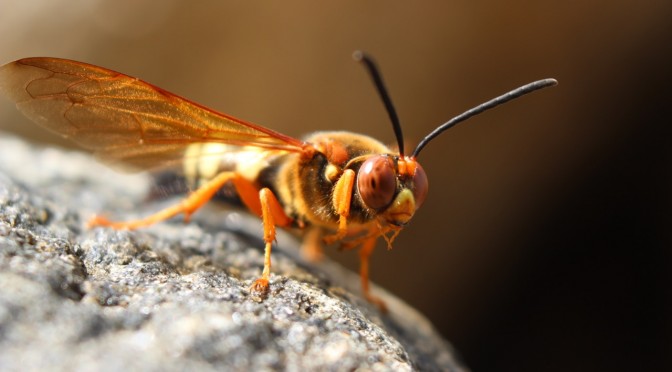
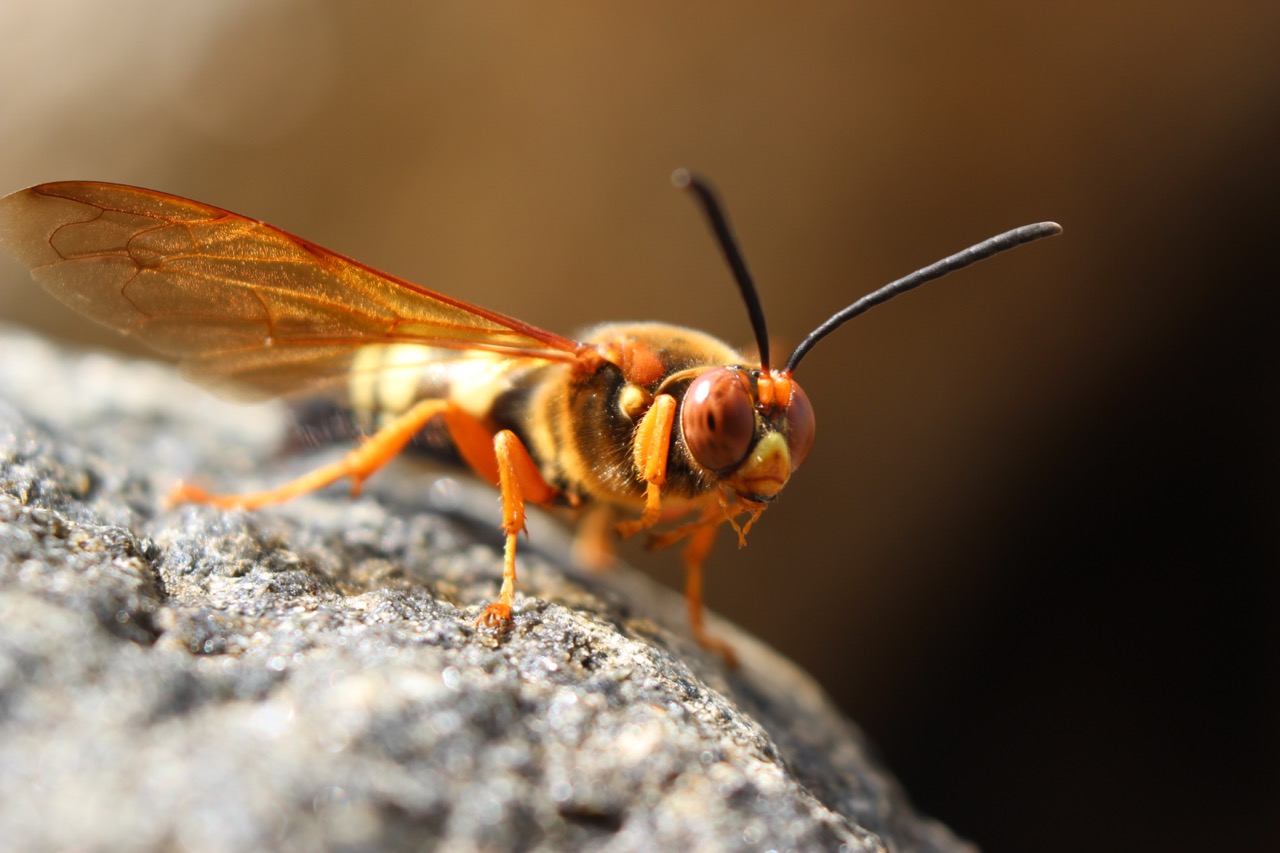
This past Wednesday I found myself thinking about Hollywood Horror Films while crouched along a hot sunny rock wall on the UW-Madison campus patiently waiting for one of our largest wasps to land mere inches from my face. What gives?Cicada Killers: One part cold-blooded killer, one part flying teddy bear (check out how fuzzy that thorax is!).
Territorial male cicada killer wasp trying to stare me down for getting too close to his rock. Photo credit: PJ Liesch, UW-Entomology [Click for a larger image]Part of their basic biology plays out like a B-Class horror movie: a victim (cicada) is injected with an incapacitating chemical before being dragged to an underground lair and left to be eaten alive. While it sounds bizarre, this is actually fairly common in the insect world and there are many examples of wasps that paralyze their prey and haul them off to their nests in the ground to feed to their young. (One of my favorites is the Zombie-making “emerald cockroach wasp“)
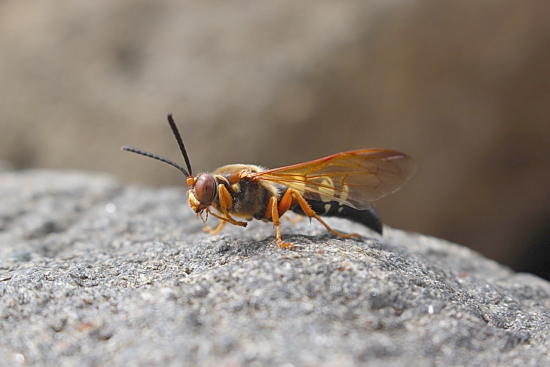
Sometimes pushing two inches in length, cicada killer wasps (Sphecius speciousus) are amongst our largest wasps in the Midwest and resemble large yellowjackets. They specialize in tracking down and attacking cicadas, which the females haul back to the nests they had previously dug in patches of bare soil. Despite their “killer” habits, these insects are usually quite docile and non-aggressive towards humans. Unlike their smaller yellowjacket cousins which have a large colony to defend, cicada killers are solitary nesters. You can actually get within inches of them without provocation, although the territorial males may fly around to check you out.
Cicada killer wasp (Sphecius speciousus) on the UW-Madison campus. Photo credit: PJ Liesch, UW-Entomology
Cicada killers can be common in the state and also happen to be common on the UW-Madison campus. You can often find them near some of the dorms along the Lakeshore bike path and also in the rock wall along the Linden Drive pull-off near the Nutritional Sciences Building (just in case you’re in the mood to meet them up-close and personal.) . They’re also common many other places in Wisconsin and the eastern US in areas with sandy soil.
In the mood for an actual horror movie involving giant predatory wasps? The recently released “Stung” might be perfect for you. . .
If you’re looking for additional information on Asian giant hornets and their look-alikes in our area, check out this post.
Note: A factsheet with additional information about the Virburnum Leaf Beetle can be foundhere.
One of Wisconsin’s newest invasive species has been popping up in Milwaukee and Ozaukee counties this spring and summer. The invasive Viburnum Leaf Beetle (VLB) is originally from Europe and was first detected in North America in eastern Canada in the 1940’s. By the 1990’s, it had been detected in New England and is now scattered across much of the northeastern part of the country. This insect can cause significant damage to viburnums. In some cases, entire plants can be defoliated and plant death can occur.
An isolated infestation of viburnum leaf beetle was detected in Dane Co. in 2009, but was quickly eradicated. Last summer, VLB was detected in Glendale (Milwaukee county) on a mature plant and has since been found on other viburnums in area .
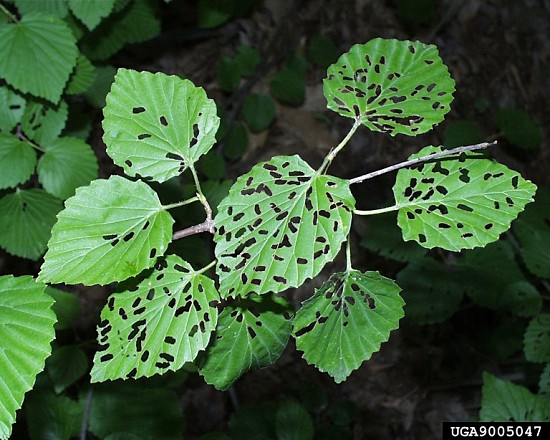
Feeding damage from adult viburnum leaf beetles. Photo courtesy of Paul Weston, Cornell University, Bugwood.org
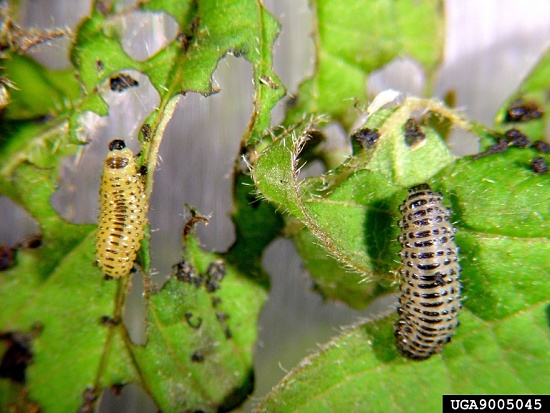
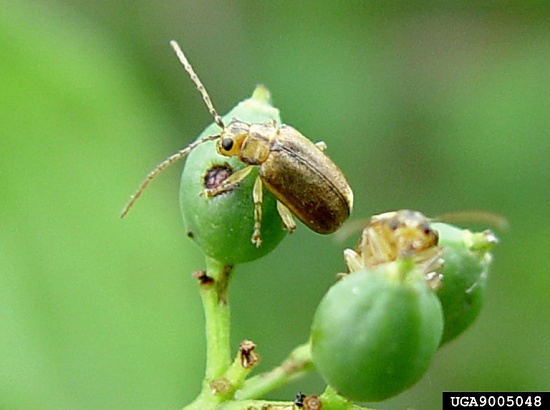
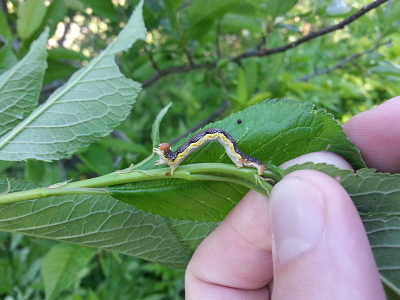
The larvae (up to 1/3″ long; yellowish in color with black spots and dashes) and adults (~1/4″ long; yellowish-brown beetles) can cause significant damage to viburnum plants, especially Cranberrybush and Arrowwood viburnums.
Viburnum leaf beetle larvae. Photos courtesy of Paul Weston, Cornell University, Bugwood.org.Adult viburnum leaf beetle. Photos courtesy of Paul Weston, Cornell University, Bugwood.org.
At this point, all of the known finds are confined to northern Milwaukee county and southern Ozaukee county, but gardeners, landscapers, and residents in southeastern Wisconsin should keep an eye out for this highly damaging pest!
A UW-Extension factsheet with additional information can be found here.
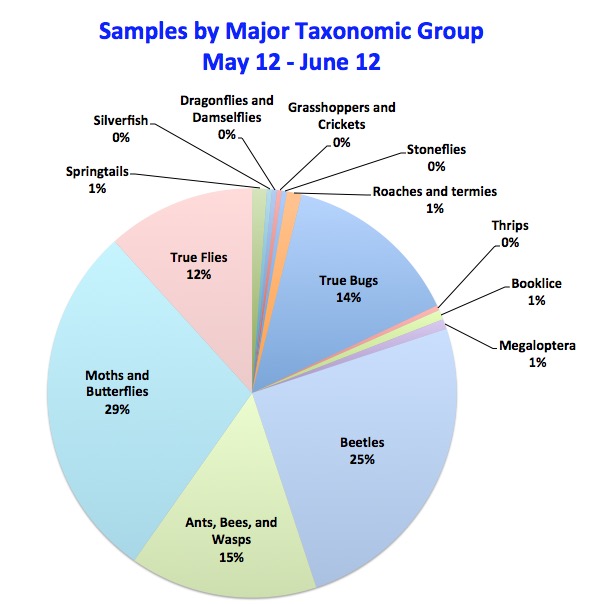
Caterpillars, and the moths and butterflies they become (Order Lepidoptera), normally make up less than 20% of the cases in the diagnostic lab, while beetles (Order Coleoptera) usually make up the largest chunk of the pie (almost 30%). However, spring often tells a slightly different story around the lab:So what does this mean?Well, as far as caterpillars are concerned, it’s been a great spring in Wisconsin. Perhaps you’ve even noticed some happily munching on the trees and shrubs in your yard. If you’re curious to meet the culprits, there’s a good chance they’re on this list:
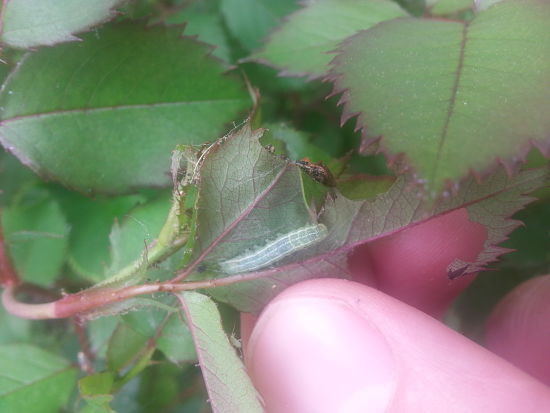
Of all the caterpillar species that have popped up this spring, the speckled green fruitworm (Orthosiahibisci) has been the biggest surprise. It’s usually present, but in low enough numbers that damage isn’t common. Despite having the word “fruit” in its name, this species feeds on more than just fruit trees—it also feeds on a long list of hardwood trees and shrubs and even some conifers. This spring I’ve had reports of it damaging: maples, oaks, hackberry, lindens, elm, serviceberry, apple, spruce, peonies, roses, and other plants.
Speckled green fruitworm on a rose bush in Madison, WI. Photo credit: PJ Liesch, UW-Entomology
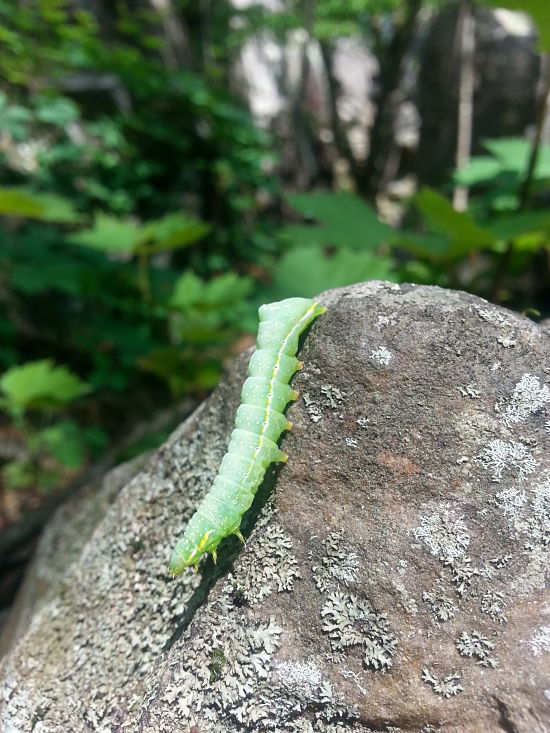
The humped green fruitworm (Amphipyrapyramidoides), has a similar feeding pattern to its speckled cousin and has also been common this spring. An interesting thing about the green humped fruitworm is that the caterpillars turn into copper underwing moths. Perhaps that name sounds vaguely familiar? If you’ve been following this blog, you may remember the invasion of the copper underwings from last summer. It’s too early to tell, but with the numbers of green humped fruitworm caterpillars I’ve been seeing, I wonder if we might see the copper-colored adults sneaking into buildings again in the coming months. . .
Green humped fruitworm on a rock near Coloma, WI. Photo credit: PJ Liesch, UW-Entomology
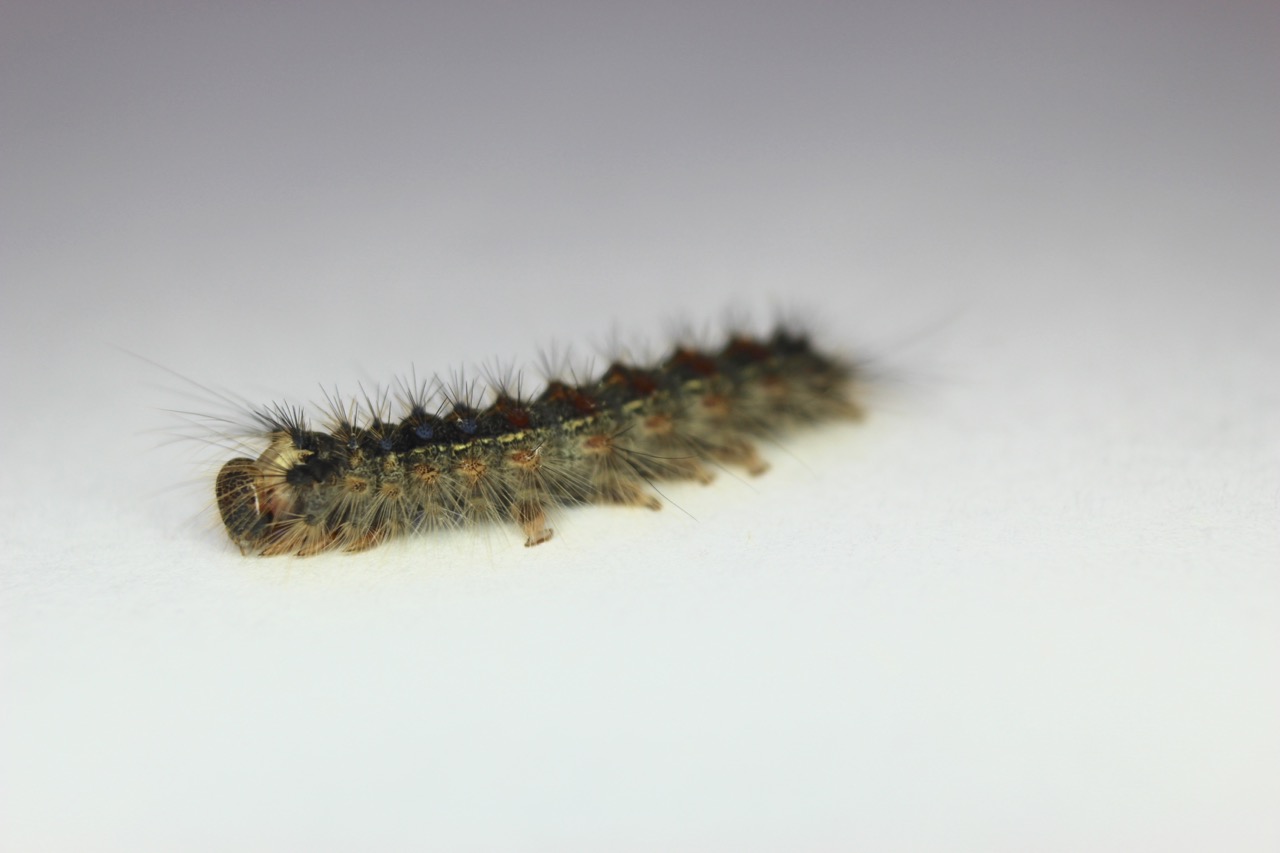
Like the fruitworms, the linden looper (Erannistiliaria; a type of inchworm) and the nefarious gypsy moth (Lymantriadispar) also feed on a wide range of plants and have been popping up this spring. I haven’t had any reports of large-scale significant defoliation by gypsy moth, but there are pockets of damage and gypsy moth certainly seems to be more active than last year at this time. Hopefully with the rains we’ve had lately, the fungal disease, Entomophagamaimaiga, will pop up to smack down the gypsy moth numbers.
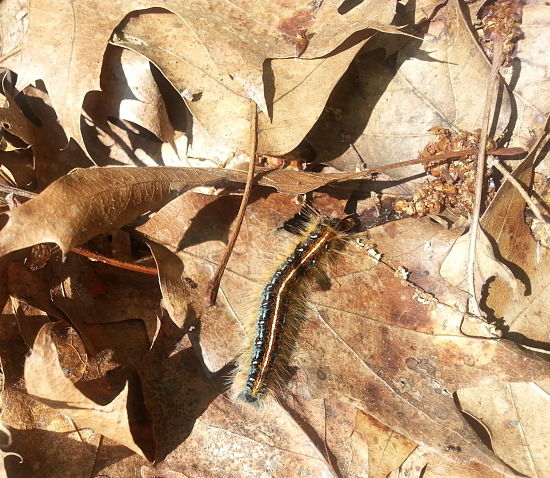
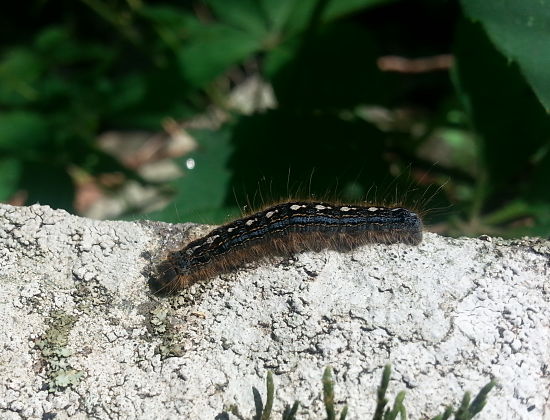
Then there are the “tent” caterpillars, which have also been common this spring: the eastern tent caterpillar (Malacosoma americana) and the forest tent caterpillar (Malacosomadisstria). The eastern tent caterpillar is the species that makes the silken tents in apple, crabapple, and black cherry trees where the branches meet the trunk of the tree. Despite its name, the closely related forest tent caterpillar doesn’t make any tents…
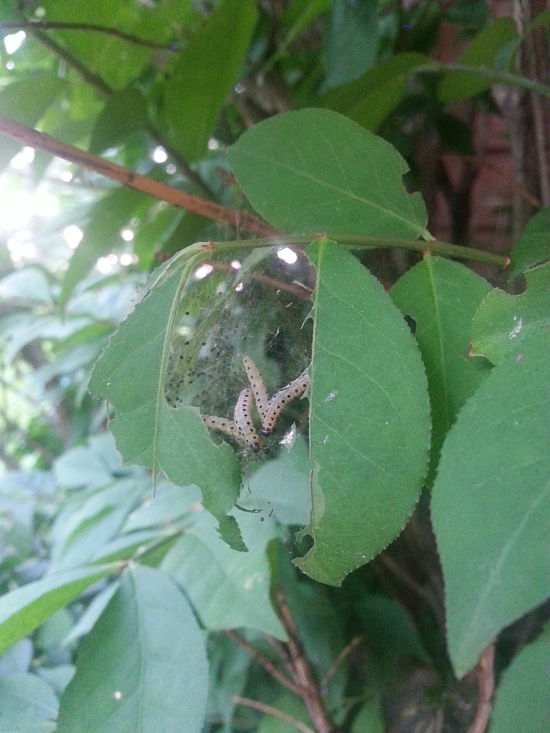
Lastly, if you’ve got a burning bush (Euonymusalatus) or another type of euonymus, you might have noticed some webbing on your plant from the euonymus caterpillar (Yponomeutacagnagella). In some cases, the webbing from these polka-dotted caterpillars can cover the entire plant, making you think that giant mutant spiders have taken over. Complete defoliation can occur with this species, but thankfully, most healthy plants leaf out again and are generally fine.
Euonymus caterpillar and webbing on burning bush near Cambridge, WI. Photo Credit: PJ Liesch, UW-Entomology
Now for some good news: while all of these spring caterpillars have the potential to significantly damage plants, they only have a single generation per year—meaning that they’re just about done wreaking havoc for the year in the southern part of the state. That’ll give us just enough time to get ready for the next batch of insects coming up soon: squash vine borer, squash bugs, Japanese beetles and many more!
Just like the bees, the beloved Monarch (Danaus plexippus), is facing declines in North America. Unlike the bee declines, which seem to be the result of a complex amalgam of factors, a major factor jumps out when it comes to monarch declines: habitat loss. Simply put, we’ve gotten rid of much of the formerly ubiquitous milkweed in the Midwest. There’s a number of reasons for this, ranging from continued land development, farm subsidies that have resulted in the cultivation of non-crop land, and heavy use of herbicide resistant crop varieties. One scientific report suggests that the Midwest has lost nearly 60% of its milkweed over the past fifteen years.
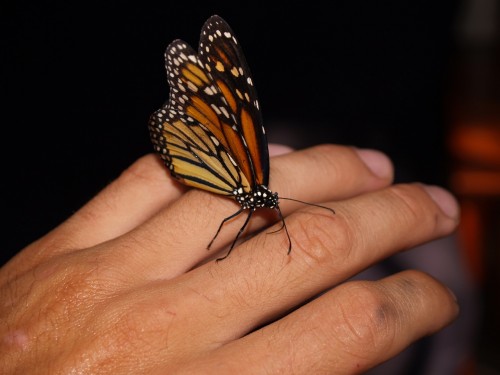
Reared adult monarch prior to release, August 2008; Photo credit: PJ Liesch
We all probably learned the general story of the monarch in elementary school: a spring northward migration, milkweed, eggs, more milkweed, striped caterpillars, even more milkweed, orange and black butterflies, and finally migration down to Mexico after a few generations (there’s a great migration video here). It’s bad enough that the sole summer food source of the monarchs (milkweed) has been disappearing, but monarchs are actually fighting a multi-front battle, as their overwintering habitat is disappearing as well. Over the past few decades, much of the overwintering territory in Mexico has been lost, degraded, and fragmented by logging (both large and small scale). What’s really concerning is that the overwintering territory isn’t all that big to begin with, making the insects vulnerable to extreme weather events. A brutal winter storm in January of 2002 killed roughly 75% of the monarchs at some overwintering sites. If monarchs keep getting squished into smaller and smaller areas, all it could take is a few bad winter storms to crash their numbers. Talk about putting all your eggs into one basket. . .
So why the fuss about monarchs now?
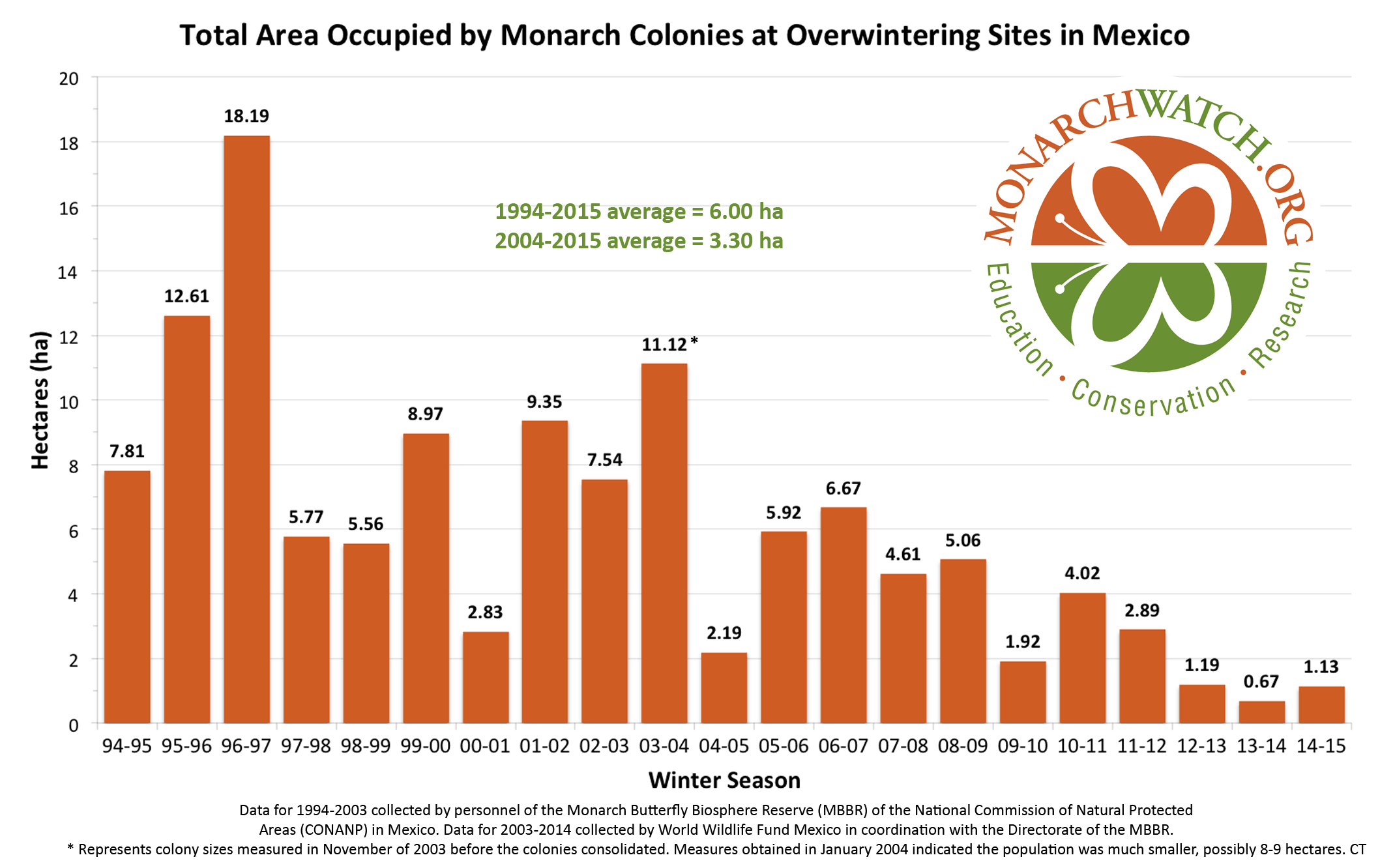
Over the past two years, the number of monarchs overwintering in Mexico has been the lowest in the history of the annual surveys.
With enough support, could we also pull the iconic monarch out of harms way? Having the assistance of the President of the United States certainly helps. Just yesterday, the white house announced that the Pollinator Task Force (created in 2014) has released its plan to help pollinators. The three main goals of the plan are: 1) reduce honey bee losses to sustainable levels, 2) preserve the monarch population in the US, and 3) increase and improve pollinator habitat (full details here).
This isn’t the first time we’ve recognized a species at risk and created a recovery plan. A classic success story: the iconic bald eagle. It’s estimated that in the mid 1900’s there were just over 400 pairs of bald eagles left in the contiguous US. These days, anyone passing through Sauk City, can tell you bald eagles have certainly rebounded.
While the Pollinator Task Force’s plan will take some time, there are things we can all do to immediately provide assistance for monarchs:
1) Plant milkweed to create a habitat for monarchs
2) Get involved with citizen science projects to educate ourselves and others
3) Use caution when using pesticides in the landscape to minimize impacts to monarchs, bees, and other beneficial species
I think it’s safe to say that just about everyone knows and appreciates honey bees (who doesn’t love honey after all). Humans have a long history with honey bees and European settlers purposefully brought them over to the Americas. However, there’s another piece of the pollinator picture which is often overlooked and under appreciated: our many native bees.
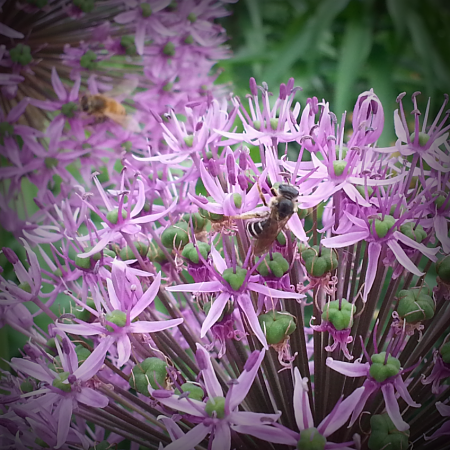
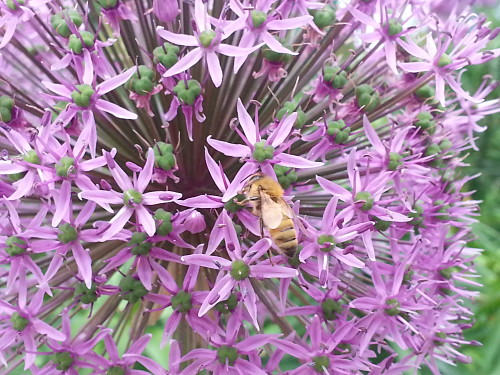
A native bee visiting flowers in the Allen Centennial Gardens on the UW-Madison campus, July, 2014. Photo Credit: PJ Liesch
How could they go unnoticed? A bee’s a bee, right? Not quite—If you take the time to learn about Wisconsin’s bees, you might be surprised to discover that we have approximately 500 species of bees in Wisconsin alone. (Then there are the many flies and wasps that are often mistaken for bees, but I’ll save mimicry for another day.) A common example of a native bee would be the metallic green “sweat bees” (Family Halictidae), although many different species exist within that family alone.
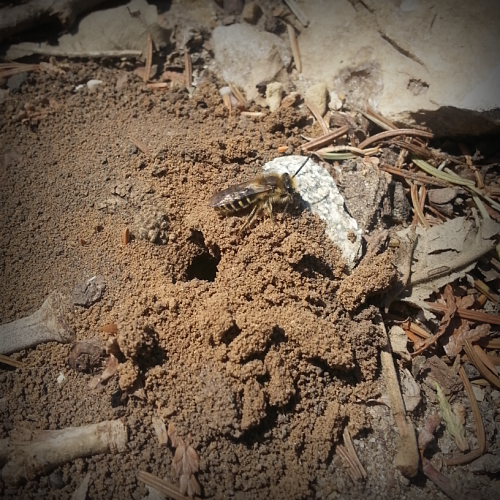
Most of our bee species are native, solitary creatures with their own unique habits. With their solitary nature, each female makes her own nest and there’s no colony of relatives to defend (unlike honeybees). With that said, our native bees tend to be rather docile, allowing for plenty of opportunities to observe them foraging at flowers or constructing their nests. Depending on the species, our native bees tend to nest in the ground (the females dig tunnels) or inside of hollow chambers. These hollow chambers could be a tunnel made in wood or a hollow plant stem. Regardless of the nesting site, the story is similar: the female bees gather food (pollen and nectar) to stash away in the nests for their young. Depending on the species of native bee and the type of plants in the area, native bees can actually be more effective at pollinating than honey bees. Thus, the importance of these native bees is often overlooked and under appreciated.
A ground nesting bee near the stump of the former President’s Oak on the UW-Madison campus. Photo Credit: PJ Liesch
Like honey bees, many native bees are facing declines for a number of reasons. One of the best things to do is to learn about native bees and other pollinators and to make your yard pollinator friendly by providing floral resources and nesting habitat.
The case load is generally pretty quiet around the UW-Madison Insect Diagnostic Lab during the first few months of the year. There are still the cases of conifer seed bugs or multicolored Asian lady beetles which are the norm for January, February and March. Occasionally I get some interesting specimens (like the cedar tree borer) which emerge from firewood that had been brought in and stored next to the fireplace. My most interesting case lately has been a sample which I was convinced contained small, hairy carpet beetle larvae. I placed the specimen under the microscope to confirm my suspicions, only to be surprised to find that it had a lot more than six legs. With that one glance, the mundane had become the bizarre. I vaguely recognized the creatures I was staring at through the microscope, as I must have seen them in a book once before.
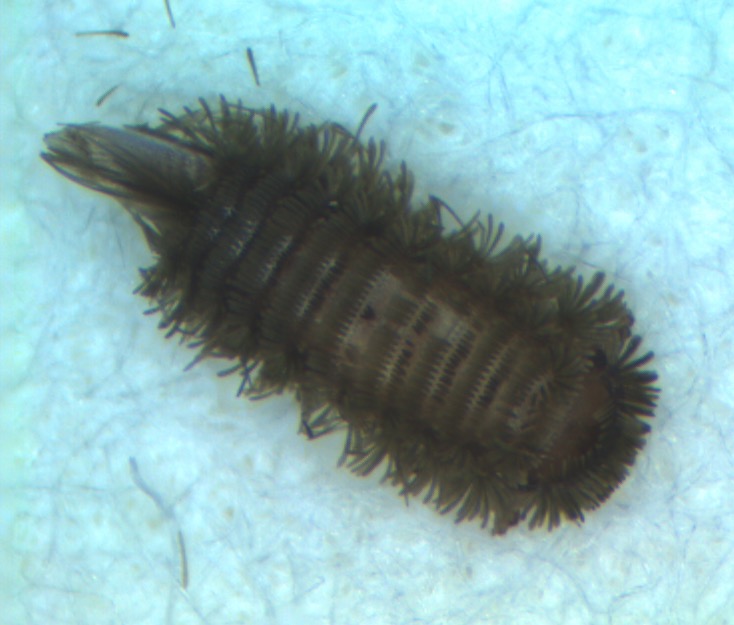
A few minutes of digging and I had my ID: an unusual type of millipede called a “duff millipede” or “dwarf millipede” from the genus Polyxenus. At only a millimeter or two long, these millipedes are hardly noticeable unless they’re moving against a light colored background. Typically, when I hear of millipedes, I think of the slow-moving, dark-colored, creatures that curl up when disturbed and are frequently associated with moisture and decaying organic matter. When it comes to duff millipedes, you have to take most of your preconceptions about millipedes and throw them out the window. Not only are they incredibly small, but their armature of spines makes them resemble a miniature hedgehog (cuteness, included) or some kind of character from the Muppets.
A “duff millipede” (Polyxenus species). Photo Credit: PJ Liesch
So what do these little spine-balls do anyways? If you dug into the literature, you’d find that they’re often associated with tree bark, leaf litter, or old stone walls and are thought to feed on algae. Other than that, there isn’t much known about them—except for their fascinating defensive mechanisms. Most millipedes rely on chemical defenses to keep predators at bay (including the ability to secrete cyanide). Some polyxenids take a very different approach and use a physical defense consisting of detachable, barbed spines reminiscent of those novelty “finger trap” toys from childhood. Thomas Eisner and colleagues found that these detachable spines can get hooked on the bodies of would-be predators (such as ants), allowing the millipede to escape while the hungry predator attempts to extricate itself. Like the “finger trap” toys, the more the predator struggles to free itself, the more entangled the barbs become. In some cases, the predators can even die from this entanglement. [You can read a detailed description of this defensive mechanism here:http://www.pnas.org/content/93/20/10848.full.pdf]
Entanglement by microscopic millipedes: what a way to go. . .
Below you’ll find the third and final part of a series describing the Top 10 insect-related stories of 2014 from Wisconsin.
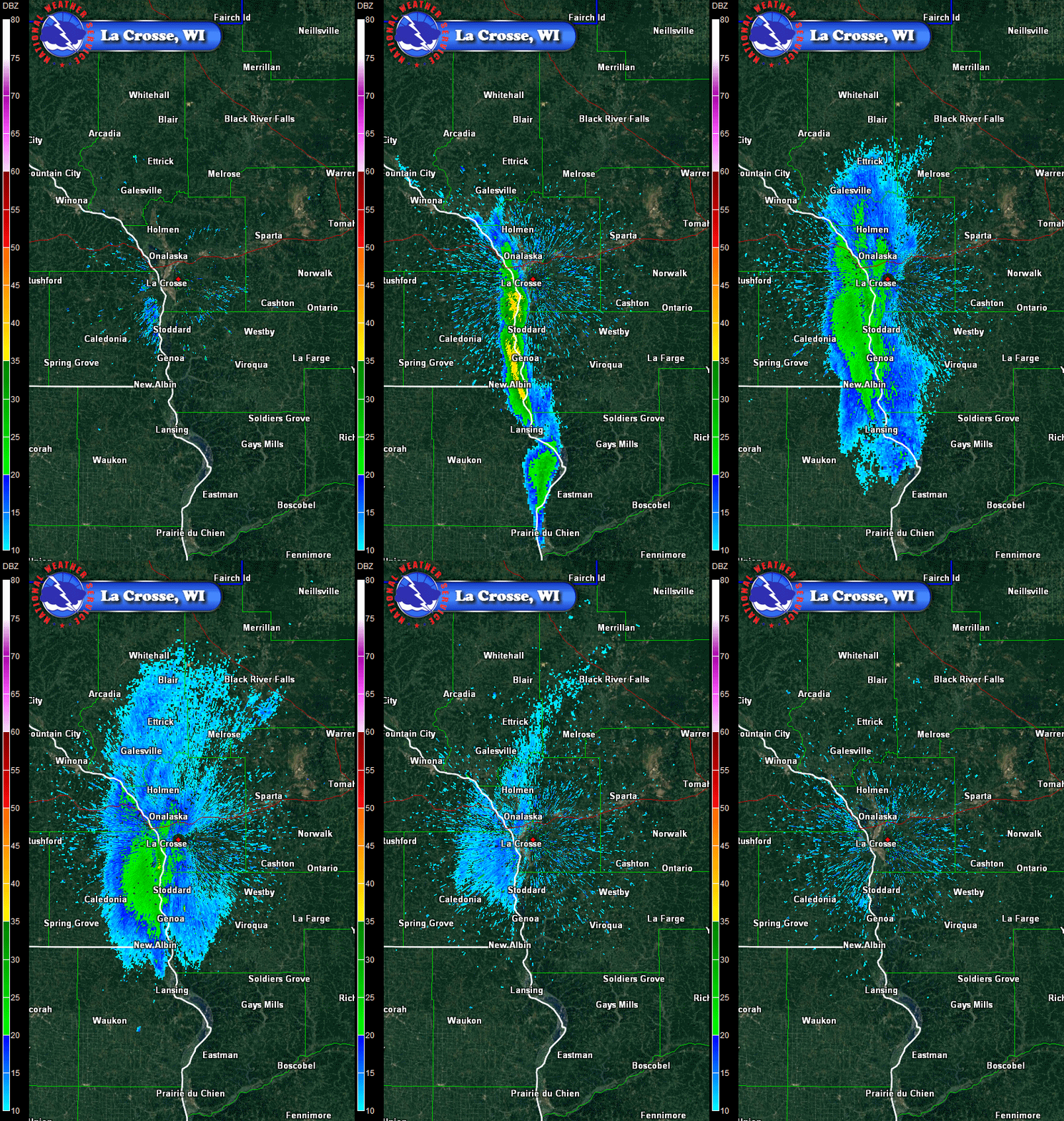
4) Hexagenia Mayflies and Fishing Spiders: If you love insects and/or fly fishing, you might have been thrilled to hear about the massive mayfly hatch along the Mississippi River in late July. These emergences happen yearly, but the mass emergence in the evening of July 20th was one of the largest in decades. We’re not talking about thousands or millions of insects, but billions of insects emerging at the same time. So many mayflies emerged simultaneously that the insects showed up on National Weather Service weather radar (a history of these events can be found here). When these emergences occur, the insects can accumulate on bridges and streets making roadways slippery.
Mayfly emergence on the evening of July 20th. Source: National Weather Service.
The insect involved is the Hexagenia mayfly. The young (nymphs) live in the sediment at the bottom of the Mississippi River and feed on bits of organic matter in the water. The presence of the adults above water is truly an ephemeral phenomenon; it’s even reflected in the name of their group: the Order Ephemeroptera. Adult Hexagenia mayflies only live for a matter of hours, which leads them through a frenzied courtship period. Shortly thereafter, they’re done for.
Around the same time as the mayfly emergence, the fishing spider stories made their way around television, radio, and Facebook and the phone calls and emails came flooding in. Despite the hype, fishing spiders are native to Wisconsin and can actually be fairly common. Fishing spiders aren’t truly aquatic, but they do tend to hang out near water. They’re among our largest spiders in the state, and can be large enough to capture and feed on small minnows.
3) Spotted Wing Drosophila: One of our newest invasive species had another strong year in 2014. The spotted wing drosophila (SWD) is originally from parts of Asia, and was discovered in the US in 2008. Within two years, it had popped up in Wisconsin. Like other fruit flies, SWD loves fruit. The main difference is that our run-of-the-mill fruit flies lay eggs in overripe or spoiled fruit. In contrast, SWD females have a hacksaw-like egg-laying structure, which can be used to slice into ripe or ripening fruit to lay eggs. As a result, SWD has become a major issue for fruit growers in the state. Late-season berry crops (raspberries, blackberries, strawberries) are hit the hardest. SWD has been found statewide, and will continue to be a major concern for late-season fruit growers for the foreseeable future.
2) Pollinators: You don’t have to listen to the news very long before you hear a reference to pollinators. Unfortunately, much of the news on the topic paints a bleak picture: pollinators of all kinds are in decline at the moment. Honey bees, bumble bees, other native bees, and butterflies like the Monarch are all facing declines. Unfortunately, it’s not a black-and-white situation, and there’s no simple solution to the issue at hand. Instead, many different factors, such as habitat loss, diseases, parasites, land-use practices, pesticides and other factors may all be involved one way or another.
We may not think of the connection to pollinators when we visit the grocery store, but without the pollination services of insects, the produce section would be scarce. It turns out that roughly a third of the world’s agricultural crops rely on pollinators. Without pollinators, you’d have a hard time finding apples, strawberries, melons, tomatoes, and many of our common food items.
Flowering plants in your yard provide resources to bees. Photo Credit: PJ Liesch
If there’s a silver lining to the situation, it’s that attention has been brought to the topic. In June of 2014, the White House announced the creation of a pollinator health task force to develop a national strategy to help prevent pollinator losses and help improve pollinator habitat. While it may seem like a small step, individuals can help pollinators by making their own yards pollinator friendly. Incorporating native plants into the landscape, providing nesting habitat for solitary bees, and using caution with pesticides are all ways to help pollinators in our own yards. Tips for accomplishing this can be found here.
1) Emerald Ash Borer: The emerald ash borer (EAB) continues to be one of the biggest insect stories in the state. This invasive pest is originally from Asia, but has been wreaking havoc on Wisconsin’s ash trees since 2008. Spread within the state seemed to progress slowly at first, but 2014 saw dramatic changes in our quarantine map in the state. In early 2014, we had a total of 21 Counties quarantined for EAB. By the end of the year, 16 additional counties had been added to the map to bring the total up to 37 counties. While most of the quarantined counties are in the southern half of the state, Douglas and Oneida counties in the north are also quarantined. Unfortunately, this destructive pest is difficult to detect and easily transported in firewood, which means that this pest will only spread and the situation will worsen over time. While we have options to protect individual ash trees (available here), we don’t have a way to protect ash trees in woodlots or forested areas. Since its introduction into the US, the emerald ash borer has killed tens of millions of ash trees. With over 700 million ash trees in the state, Wisconsin has a lot at stake.
Below you’ll find the second part of a three part series describing the Top 10 insect-related stories of 2014 from Wisconsin. Part three will be released next week.
7) Missing Pests: As every landscaper and farmer knows, there’s a certain batch of insect pests that tend to pop up consistently each year. One of the biggest stories of 2014 was the scarcity of some of these “regulars” like the gypsy moth and the Japanese beetle. The reason behind this? We likely have Mother Nature to thank. Gypsy moth populations fare poorly during periods of wet weather due to the proliferation of a fungal disease that kills the caterpillars. We certainly had abundant and consistent rainfall in 2014, and several images of diseased insects made their way into the lab. In addition, gypsy moth numbers have been in a general decline for several years in the state, which is good news for oak trees.
If there’s one good thing that came out of the brutally cold winter of 2013-14, there’s the fact that it may have helped knock down the Japanese beetle populations. Japanese beetles overwinter as white grubs in the soil and tend to move just deep enough to avoid the frost line. With the pipe-bursting cold and deep frosts of last winter, it seems that the deep freeze knocked their numbers down. As a result, reports of damage from Japanese beetles were scarce this past summer. While it’s too early to tell, it’s possible that it may only be a one-year reprieve. Turfgrass researchers have reported decent grub numbers in turfgrass areas this fall, which could mean that Japanese beetle numbers could creep back up in the future.
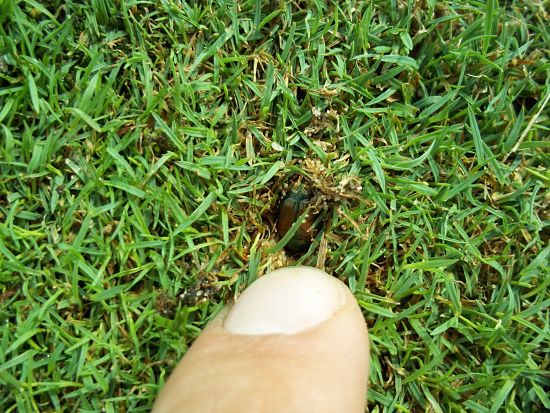
A female Japanese beetle digging into the turf to lay her eggs. Photo Credit: PJ Liesch.
Agricultural pests were also down in 2014, with no major pest outbreaks. Two of our best known corn pests, the European corn borer and corn rootworms, had very slow years. Even migratory crop pests, such as the potato leafhopper and black cutworm, which overwinter in the gulf coasts states and migrate northward in the spring failed to take off in 2014. (A full summary of agricultural pests can be found here.)
6) Interesting “Structural Pest” Trends: Two of our insects that commonly invade homes in the fall (boxelder bugs and multi-colored Asian lady beetles) had drastically different trends this year. Box elder bugs thrive under dry conditions, like we had in the latter parts of 2012 and 2013. Similar to the gypsy moth mentioned above, the damp conditions in 2014 likely helped keep the box elder bug number in check and prevented the widespread numbers that we’ve seen the past few years. While the numbers of box elder bugs were low this fall, the multicolored Asian lady beetle, which had been low for the past few years, started popping up in decent numbers in certain parts of the state. One warm October day, I wandered out to the front of the entomology department building on campus to view thousands of the lady beetles flying around looking for overwintering spots.
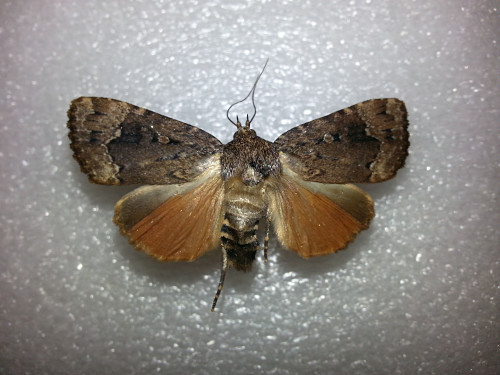
5) Invasion of the Copper Underwing: Most folks have never heard of a moth called the copper underwing. Rightly so, as it tends to be a fairly obscure species. The caterpillars are commonly called the green humped fruitworms and can feed on fruit trees and other trees. When adults rest on trees, their grayish appearance isn’t much to write home about. However, when they display their hind wings, you’d notice the brilliant copper color and understand the common name of the insect.
For whatever reason, 2014 seemed to be perfect for this species. Perhaps I should have suspected that the few adults I spotted at my porch lights in late spring were the beginning of a trend. As the summer went on, I started getting reports of large numbers of these moths congregating on the sides of homes, sneaking under siding, and even leaving excrement stains on siding. All in all, I had reports of “home invasions” from over a dozen counties, mostly in the southwestern part of the state. Because this species tends to be present in low numbers, I suspect that we won’t see them amassing by the thousands again anytime soon.
The year-end stats are in: a grand total of 2,092 insects, mites, spiders and other curiosities were submitted to the Insect Diagnostic Lab in 2014. With the ubiquity of smart phones and internet access, nearly 60% of the cases handled in the lab this year consisted either solely of digital images or as digital images accompanying a physical specimen. While the vast majority of cases came from within Wisconsin, there were occasional images and questions sent in from other states and even other countries (including Mexico, England, Ireland, South Africa, India, Guatemala, the Philippines, Spain, Portugal, Afghanistan, and Jamaica).
When it comes to the insects in Wisconsin this past year, several stories pop out. First of all, several of our “usual” pests were noticeably down this year: gypsy moth, Japanese beetle, and box elder bugs, to name a few. In contrast, the emerald ash borer had quite a year and was detected in many new locations, leading to over a dozen counties being added to the quarantined zone in the state. Then there were some cases that seemed to appear overnight: the spring mosquitoes and the massive mayfly hatch in late July.
Below you’ll find the first part of a three part series describing the Top 10 insect-related stories of 2014 from Wisconsin. Parts two and three will be released over the next two weeks.
10) Mosquitoes: Our unofficial “state bird” made news headlines across the state starting Memorial Day weekend. In some spots, the mosquitoes were so bad, that outfitters of recreational canoeing trips were turning customers away, lest they fall victim to the winged vampires.
What caused the mosquito problems in 2014? It boils down to some ideal conditions, as far as the mosquitoes are concerned. With over 50 species of mosquitoes in the state, each species has its own unique habits. Some rely on the moisture from melting snow to develop. Others wait for rain to flood depressions in the woods, where female mosquitoes had laid their eggs. Some other species rely on more permanent bodies of water, such as drainage ditches and rain-filled containers. With the late snowmelt and the heavy rains this spring and summer, our mosquitoes had plenty of moisture to use.
If there’s a silver lining of the 2014 mosquito season, it’s that the number of West Nile cases were down in the state. It turns out that our heavy rains created temporary pools out in the woods, which are favored by our “floodwater” mosquitoes. For the most part, these species are a nuisance, but don’t carry diseases like West Nile. The mosquitoes that spread West Nile tend to prefer more permanent bodies of water. When you have lots of rain, it can sometimes cause these more permanent bodies of water to overflow, flushing the mosquitoes away. It may be counterintuitive, but our worst West Nile year of the past decade was actually the droughty year of 2012.
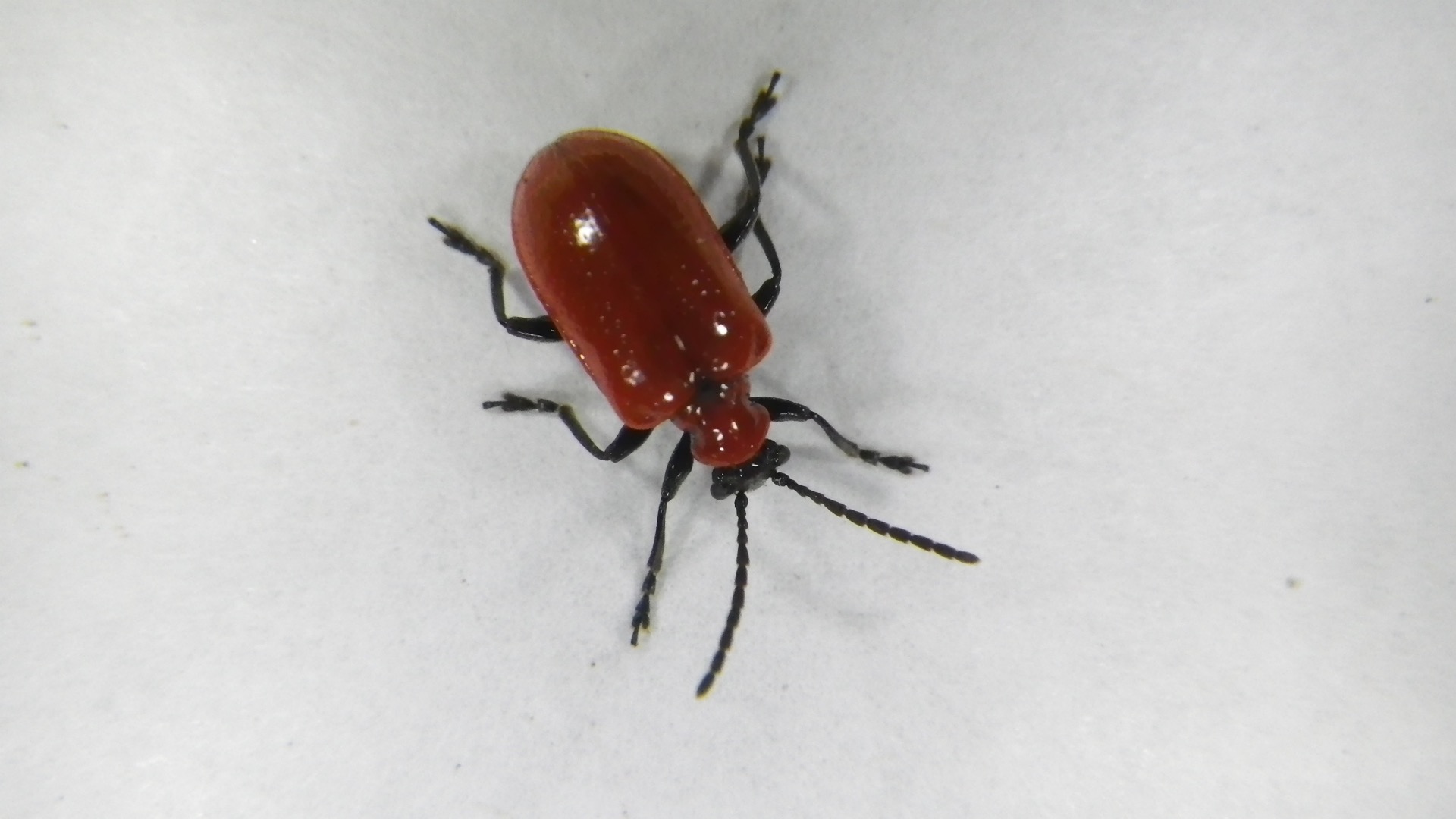
9) Invasive Leaf Beetles: Two different species of invasive leaf beetles (Family Chrysomelidae) were detected in Wisconsin this past year: the lily leaf beetle and the viburnum leaf beetle. Both of these beetles have unusually similar histories: they’re both known from Europe but were found in Canada in the mid-1940’s. Both made their way into New England in the 1990’s and have been popping up in other locations since then.
The lily leaf beetle was detected for the first time in Wisconsin in July in the Wausau area. This species feeds on true lilies in the landscape and has been found at a handful of sites in Marathon and Wood counties. The viburnum leaf beetle had technically been found once before in the state a few years ago in Dane county. At the time it had been found on a recently planted viburnum bush, which was removed and the insects were eradicated. Technically, the case that popped up in the Milwaukee area in late summer on an established viburnum bush is our second record in the state. Unfortunately, the original source of the insects and extent of the current infestation are not fully understood at this point.
While these two beetles have only been found in a few isolated spots in the state, they have the potential to cause significant damage to their host plants, so gardeners should keep a watchful eye out for them in 2015!
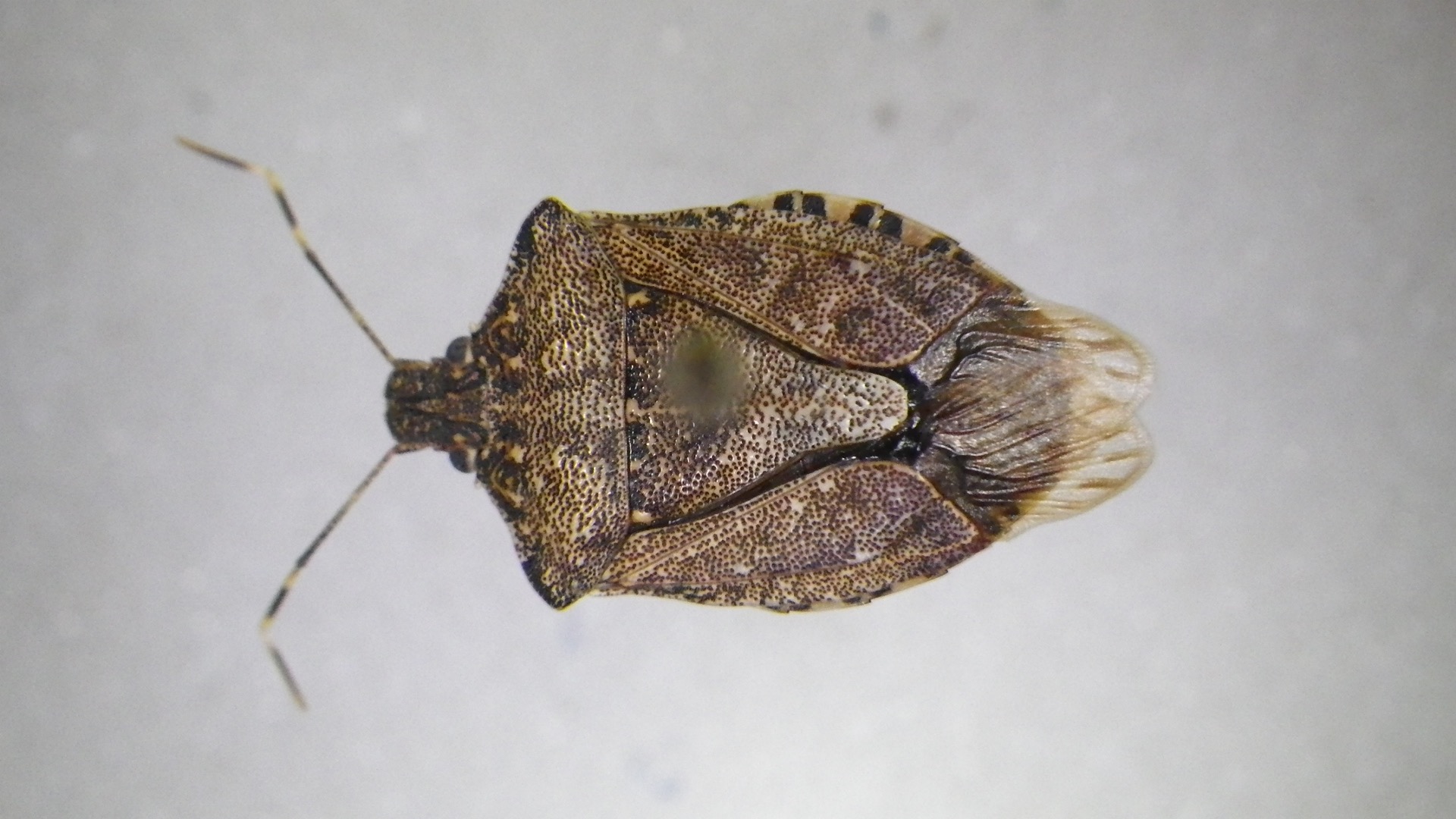
8) Brown Marmorated Stink Bug (BMSB): This invasive pest was first discovered in the state in 2010. When I describe BMSB during presentations, I joke that it’s as if a mad scientist in a bad Sci-Fi movie had somehow crossed a Japanese beetle with a box elder bug. Like Japanese beetles, BMSB will feed on hundreds of different types of plants: field crops, vegetables, fruits, and ornamental plants can all be damaged. In addition, BMSB has the habit of sneaking indoors in the fall like box elder bugs. In other parts of the US (such as Pennsylvania and Virginia), BMSM has been wreaking havoc on agricultural producers and homeowners alike. Luckily, this stink bug has been quiet the past few years in Wisconsin and we saw more of the same for 2014. While I only had half a dozen samples documented in the state this year, this is certainly a pest that everyone should be keeping an eye out for in the future.
Brown Marmorated Stink Bug (Halyomorpha halys); Photo Credit PJ Liesch
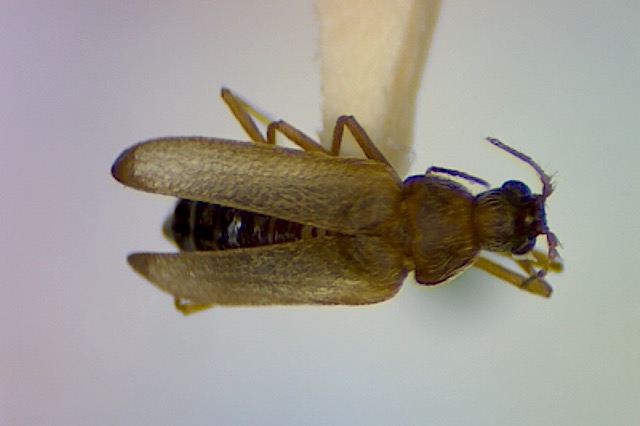
Meet Thylodrias. Kind of sounds like a character from the Game of Thrones. But alas, it’s just an odd beetle about the size of the letter “d” in size ten print.
Adult male odd beetle (Thylodrias contractus); Photo credit PJ Liesch
Although, technically speaking, this one’s not just an odd beetle. It’s more like the king of odd beetles, so much so, that it’s actually known as the odd beetle. Kind of weird for a species belonging to a very common family: dermestidae. Other relatives in the dermestid bloodline include the common hide, larder, and carpet beetles, which occasionally find their way into that old, half-empty box of spaghetti noodles at the back of the kitchen cupboard. However, if you made a closer examination of the dermestid family tree, you’d find that the odd beetle sits alone: a solitary species in its own genus.
By now, you may be wondering: what really makes this one so odd? For starters, it’s a bit infatuated with humans and we only know of the species from human habitations. We even know of specimens from archaeological sites in Iran, but these days it’s most commonly found in museums. It’s somewhat ironic that such an interesting and unusual insect has a history of lurking around the home of the UW-Madison entomology department: Russell Labs1. Like many other museum pests, the odd beetle wanders around looking for a protein-rich meal to feed on. It turns out that Russell Labs is home to plenty of potential food: millions of preserved insect specimens in the Wisconsin Insect Research Collection as well as preserved mammal and bird specimens in the Forestry and Wildlife Ecology wing of the building.
In addition to popping up in weird places, Thylodrias contractus also looks downright bizarre. With the naked eye, an adult female looks more like a bed bug or a small silverfish than a beetle. Technically, the females lack wings and have a larva-like appearance, which is strange in and of itself. Even the males of this species have a peculiar appearance and bear the meekest resemblance to other members of the family. Then there’s the quirky life cycle: developing larvae can go over a year without food. If times are really hard, they can borrow a page from The Curious Case of Benjamin Button and undergo retrogressive molting. With that elasticity in its development, the complete life cycle can vary from several months to several years.
All in all, rather peculiar.
1 Mertins, J. W. 1981. Life History and Morphology of the Odd Beetle, Thylodrias constractus. Ann. Ent. Soc. Am. 74(6): 576-81.